
Temperatures in 2025 similar to 2023 and 2024, after a several year cold trend
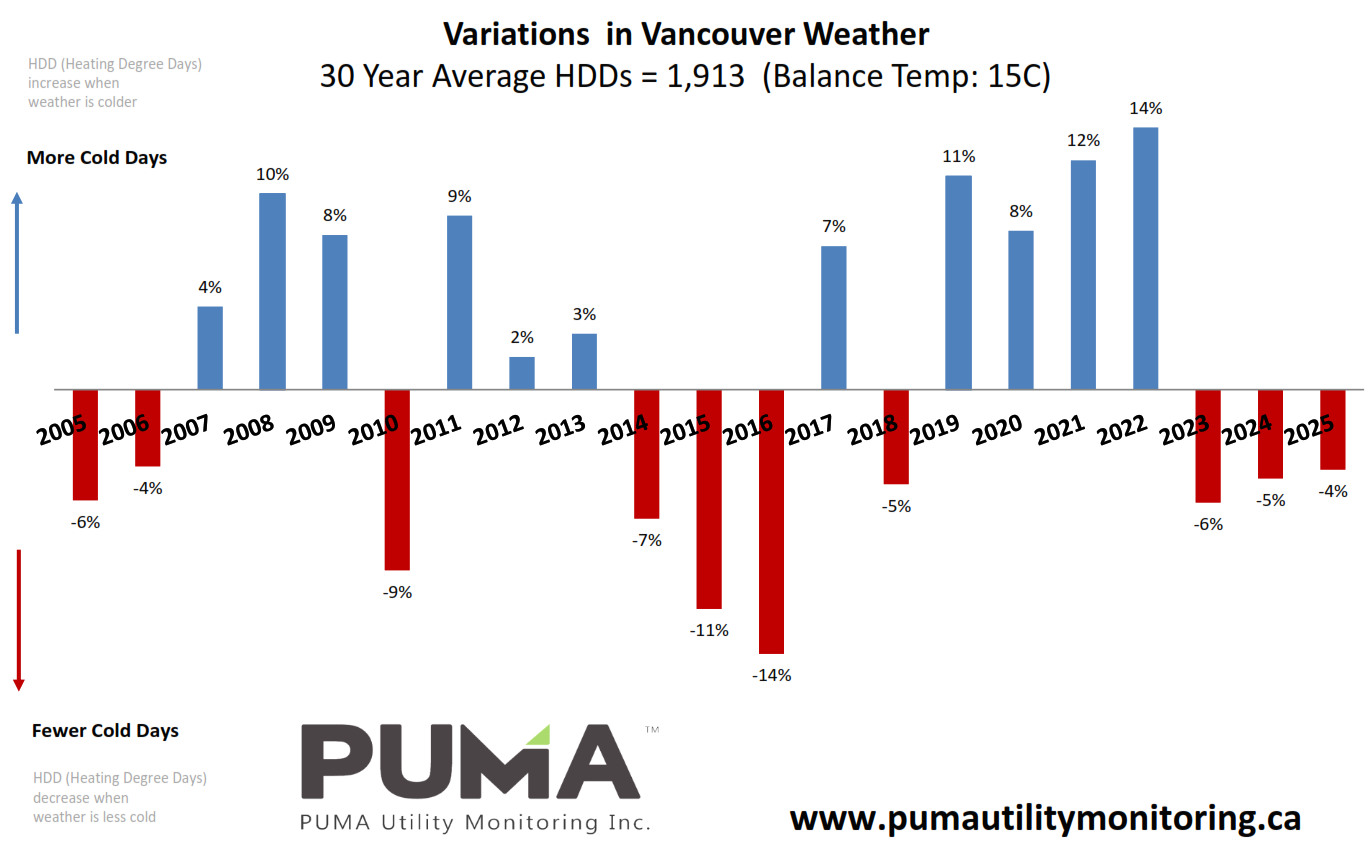
Data collected by PUMA & Environment Canada shows a similar amount of Heating Degree Days (HDD) in 2025 compared to 2024 & 2023. This follows on a 4 year trend of years with more cold days than average in 2019 through 2022.
HDDs are a key figure for predicting building energy use & are directly calculated from outdoor air temperatures & a common Vancouver balance point of 15 degrees Celsius. The balance point is the temperature below which a building requires heating.
The average temperatures in Vancouver in March, May, & November were significantly higher than those recorded in the previous year, where February & October 2025 were colder months. The data also show that Vancouver saw 4% fewer HDDs than the 30-year average (see chart above).
With such variations in temperature from year to year, it is crucial to make weather-adjusted energy use calculations to truly understand energy use in buildings.
“Weather is a major factor in energy use in buildings” says Duncan Wilcock, Client Services Lead at PUMA.
“The changing climate over the past 30 years has significantly affected how buildings use energy. We can help our clients understand why considering weather patterns is essential for understanding their building’s utility use,” he adds.